Multi-Agent Orchestration Toward Superintelligence

I’ve been thinking about the idea that the next leap in AI may not come from one giant model getting smarter, but from many specialized agents learning how to work together. One agent can research, another can plan, another can execute, and another can check the work — and when they are connected well, they start to feel less like isolated tools and more like an operating system for intelligence. That is what makes multi-agent orchestration so interesting to me: it is not just a technical architecture, it is a new way to organize intelligence.
Why Agent Teams Matter
I keep coming back to one idea:
The future of AI may not be one mind.
It may be a team.
A single model can be impressive. It can write, reason, summarize, code, search, analyze, and respond. But when you ask one model to do everything, it eventually gets stretched thin.
It has to plan.
It has to remember.
It has to retrieve information.
It has to use tools.
It has to check its own work.
It has to make decisions.
It has to execute.
It has to explain itself.
That is a lot to ask from one system.
In human organizations, we do not usually solve complex problems by giving one person every role. We build teams. We specialize. We divide labor. We create managers, operators, analysts, reviewers, strategists, and executors.
I think AI is moving in the same direction.
Instead of one general AI trying to do everything, we will increasingly see teams of agents working together.
One agent plans.
One agent researches.
One agent writes.
One agent critiques.
One agent executes.
One agent watches for risk.
One agent communicates with tools.
One agent coordinates the rest.
That is what I mean by multi-agent orchestration.
It is the shift from “AI as a single assistant” to “AI as a coordinated workforce.”
And I think this matters because it may become one of the paths toward much higher intelligence.
Not because each agent is superintelligent by itself.
But because the system becomes smarter through coordination.
A group of narrow agents, if organized properly, can solve broader problems than any one of them could solve alone. They can break down tasks, hand off work, check each other, use different tools, and operate across digital and physical systems.
That is where things get interesting.
The real question becomes:
Can we build collective intelligence out of specialized AI agents?
And if we can, what does that do to companies, jobs, science, robotics, and society?
That is what this letter is about.
Some Context
The idea of multiple intelligent agents working together is not new.
People have been thinking about distributed intelligence for a long time. Swarms, teams, markets, organizations, ecosystems, and networks all show the same basic principle: intelligence can emerge from coordination.
A single ant is not impressive.
A colony is.
A single neuron is not conscious.
A brain is.
A single employee may be limited.
A company can build something massive.
The same pattern may apply to AI.
Early AI systems were usually narrow and isolated. They were built to perform specific tasks inside specific rules. Later, AI systems became more flexible. Then large models arrived and gave us a new kind of general interface: language.
But language alone is not enough.
A model that can talk is not the same as a system that can operate.
That is why agents matter. Agents can be given goals. They can use tools. They can plan steps. They can observe feedback. They can keep state. They can take action.
But once you have many agents, a new problem appears:
How do they coordinate?
Without coordination, agent teams become chaos.
They repeat work.
They contradict each other.
They lose context.
They delegate poorly.
They make conflicting decisions.
They create unnecessary loops.
They become expensive and unreliable.
So the real breakthrough is not just creating agents.
It is creating the orchestration layer above them.
That layer decides who does what, when, why, and how. It manages context. It routes tasks. It tracks state. It enforces rules. It checks quality. It handles failures.
In other words, orchestration is the management system for digital workers.
This is also where the monolithic AI versus multi-agent AI debate comes in.
One path says: keep making one giant model smarter.
The other path says: make many specialized models and agents work together.
I do not think these paths are mutually exclusive. We will probably have both. Stronger base models will power better agents, and better orchestration will make those agents more useful.
But from a builder’s perspective, the multi-agent path feels especially practical.
Because real work is already modular.
A business process has steps.
A customer journey has handoffs.
A software project has roles.
A research project has stages.
A robot fleet has coordination needs.
A company has departments.
Multi-agent systems fit the shape of real work.
That is why I think they matter so much.
Architectures And Protocols
If you strip away the hype, a multi-agent system has a few basic parts.
First, you need specialized agents.
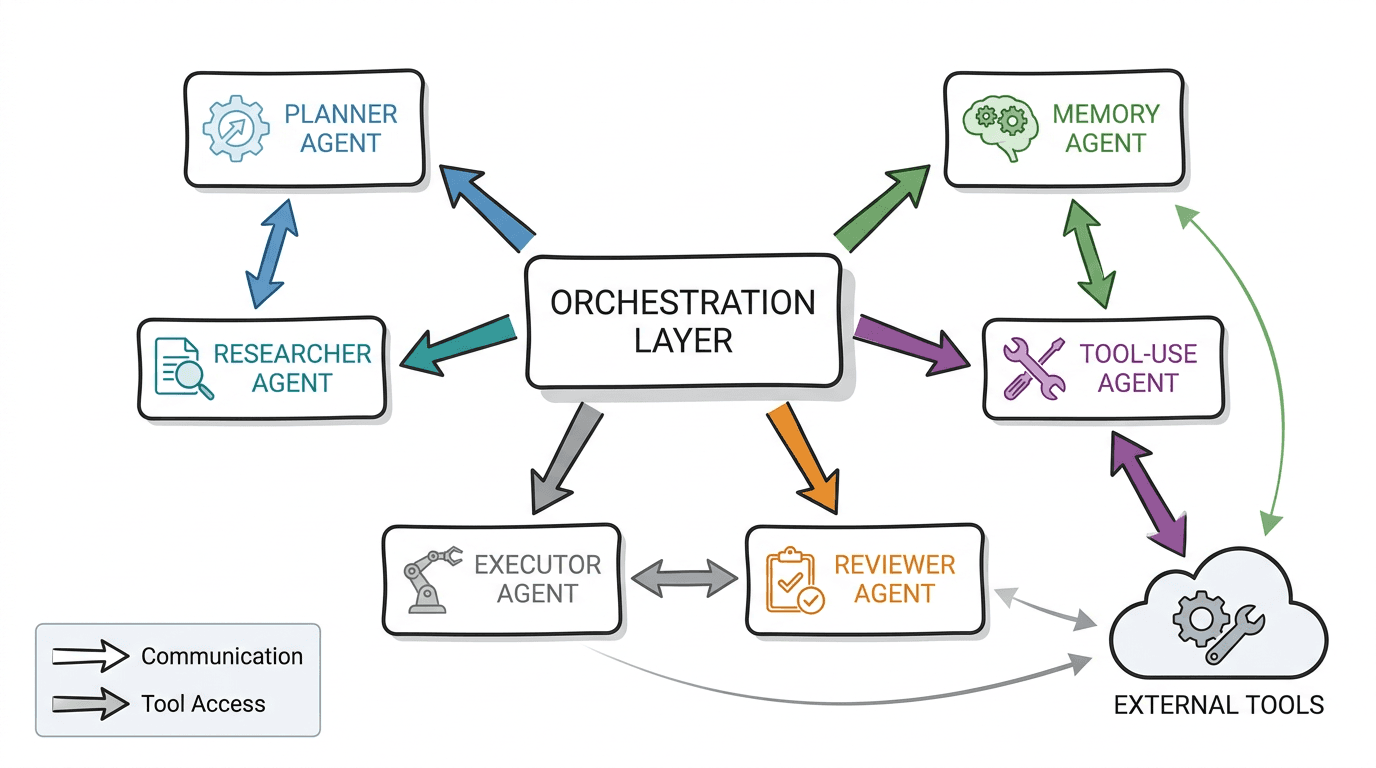
Each agent should have a role. One might be a planner. Another might be a researcher. Another might be a coder. Another might be a critic. Another might be a tool-user. Another might be a memory agent. Another might be a safety reviewer.
The clearer the role, the better the system.
Second, you need communication.
Agents need to pass messages, requests, results, decisions, and context to each other. If communication is messy, the whole system gets messy.
Third, you need shared context.
Someone or something needs to remember what has already happened. Otherwise, agents duplicate work, forget decisions, or lose the thread.
Fourth, you need control flow.
Which agent starts?
Which agent waits?
Which agent approves?
Which agent retries?
Which agent stops the process?
Which agent escalates to a human?
That logic has to live somewhere.
Fifth, you need tool access.
Agents become much more useful when they can interact with the outside world: databases, APIs, calendars, CRMs, documents, browsers, code environments, robots, sensors, and enterprise systems.
Sixth, you need governance.
The system needs permissions, logs, error handling, safety rules, and boundaries.
That is what turns a pile of agents into an actual operating system.
I’ve learned that the most important thing is not how many agents you have. It is how clearly they are coordinated.
Five well-designed agents can outperform fifty chaotic ones.
This is similar to human teams.
A small team with clear roles, trust, and communication can move faster than a large team with no operating rhythm.
The same applies to AI agents.
Robotics And Physical Integration
The next frontier is when agent teams move from software into the physical world.
Right now, a lot of AI agent work happens in digital environments: email, documents, CRMs, browsers, code, support tickets, databases, and workflows.
But eventually, agents will coordinate robots, drones, vehicles, factories, warehouses, medical devices, construction systems, and physical infrastructure.
That changes the stakes.
In software, an agent mistake may create bad data or send the wrong message.
In the physical world, an agent mistake can break equipment, hurt someone, waste inventory, damage property, or create safety risks.
So physical integration requires much more discipline.
Imagine a warehouse.
One agent monitors inventory.
Another predicts demand.
Another schedules picking.
Another routes robots.
Another checks package quality.
Another updates the customer.
Another handles exceptions.
That entire workflow can become orchestrated.
Or imagine a robot fleet.
One agent manages task assignment.
One agent monitors battery levels.
One agent maps the environment.
One agent handles human safety zones.
One agent reroutes robots when something changes.
One agent reports failures.
This is where multi-agent orchestration starts to look like a nervous system.
The agents sense, decide, coordinate, and act.
But robotics adds constraints that pure software does not have.
Latency matters.
Battery matters.
Location matters.
Physics matters.
Safety matters.
Human override matters.
Failure recovery matters.
This is why I do not think physical-world AI should be built with reckless autonomy.
It needs layers of control.
A digital agent can be creative.
A robot agent needs to be safe.
The dream is powerful: AI agents coordinating physical systems so humans can get more done with less manual burden.
But the engineering has to be serious.
When software touches the physical world, “move fast and break things” becomes a dangerous philosophy.
Core Analysis
Orchestration Architectures
A good orchestration system sits above the agents.
It is the layer that keeps the team coherent.
At a high level, this layer does five jobs:
It breaks large goals into smaller tasks.
It assigns those tasks to the right agents.
It manages communication between agents.
It tracks state and memory.
It checks quality and handles failures.
Without this layer, multi-agent systems become noisy.
With it, they can become powerful.
Think of a complex research task.
A user asks for a market analysis. The orchestrator breaks it down.
One agent studies the market.
One agent studies competitors.
One agent finds customer pain points.
One agent analyzes pricing.
One agent creates the report.
One agent checks for gaps.
One agent prepares the final recommendation.
That is much more reliable than asking one model to do everything in one pass.
The same structure applies to sales, product, engineering, finance, support, operations, and robotics.
The point is not to create artificial bureaucracy.
The point is to divide cognition.
Each agent gets a narrower job.
The orchestrator keeps the bigger picture intact.
That is how the system becomes more capable than the individual parts.
Planning And Task Decomposition
The first real job of orchestration is breaking big goals into smaller pieces.
This is where a lot of intelligence comes from.
A vague goal like “launch a campaign” is too broad. A good orchestrator turns it into steps:
Define the audience.
Research the pain.
Draft the offer.
Write the copy.
Create assets.
Build the sequence.
Set up tracking.
Launch the campaign.
Monitor performance.
Suggest improvements.
Each step can then go to the right agent.
This matters because most real-world tasks are not single actions. They are sequences.
When AI systems fail, it is often because they try to jump straight from request to answer without enough structure.
Good orchestration slows the system down in the right way. It forces planning before execution.
That is how agents become useful for complex work.
Communication And Protocols
Agents need a common language for coordination.
Not just natural language, but structured communication.
They need to know how to ask for help, pass results, request tools, report state, flag uncertainty, and escalate problems.
Without structure, agents talk past each other.
A researcher agent may produce information the planner cannot use.
An executor may act before the reviewer finishes.
A critic may identify issues but not route them back into the workflow.
A memory agent may store context in a way no one retrieves later.
The system needs protocols.
Who can talk to whom?
What format should messages use?
What information must be included?
What counts as completion?
When should an agent stop?
When should it ask another agent for input?
This sounds boring, but it is everything.
Human teams break when communication breaks.
Agent teams are the same.
State And Memory
Memory is another major piece.
Agents need to know what has already happened.
What was the original goal?
What decisions have been made?
What has been tried?
What failed?
What assumptions are we using?
What constraints matter?
What is the current state of the work?
Without memory, agents wander.
They repeat themselves. They contradict previous decisions. They lose context. They produce work that sounds smart but does not fit the actual process.
A shared memory layer helps the system maintain continuity.
This is especially important in long workflows.
A multi-agent system that runs for five minutes is one thing.
A multi-agent system that supports a company, research lab, customer pipeline, or robot fleet over months is another.
Long-running agent teams need durable memory.
Not just chat history.
Operational memory.
They need to remember goals, policies, user preferences, tool states, previous outcomes, mistakes, and lessons learned.
That is how a system starts to feel less like a prompt and more like an organization.
Quality Control And Error Handling
The more agents you add, the more failure modes you create.
One agent can hallucinate.
Another can misunderstand the task.
Another can call the wrong tool.
Another can trust bad information.
Another can approve weak output.
Another can create a loop.
Another can conflict with a policy.
This is why quality control has to be built into the architecture.
A good system needs reviewers.
It needs consistency checks.
It needs fallback logic.
It needs confidence thresholds.
It needs logs.
It needs retry behavior.
It needs human escalation.
I think this is one of the biggest mistakes people make with agent systems. They focus on autonomy before reliability.
But autonomy without error handling is not intelligence.
It is risk.
A mature agent system should be able to notice when it is uncertain, ask for help, reroute the task, or stop before causing damage.
That is what makes orchestration trustworthy.
Workflow And Robotics Integration
The practical power of multi-agent orchestration is workflow redesign.
Instead of humans manually pushing work from one system to another, agents can coordinate the flow.
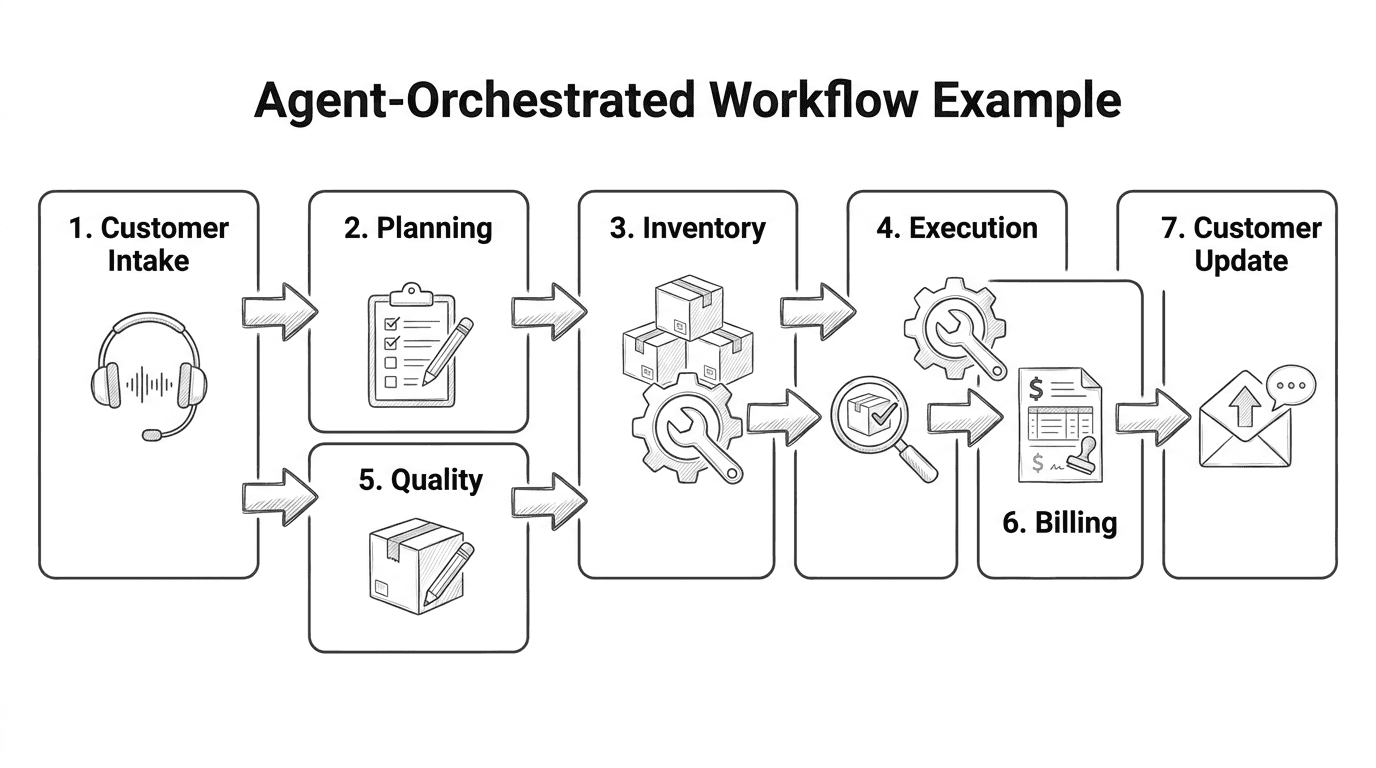
Think about order fulfillment.
A customer places an order.
One agent validates the request.
Another checks inventory.
Another handles payment.
Another coordinates shipping.
Another updates the customer.
Another checks for exceptions.
Another logs the outcome.
That is not just automation. That is a digital operating process.
The same applies to many workflows:
Customer onboarding.
Sales qualification.
Invoice processing.
Candidate screening.
Support escalation.
Research synthesis.
Software QA.
Manufacturing coordination.
Supply chain monitoring.
The goal is not to replace all humans.
The goal is to remove the manual glue work that slows everything down.
Humans should handle judgment, relationships, exceptions, strategy, and accountability.
Agents should handle coordination, routing, retrieval, summaries, repetitive execution, and monitoring.
When robotics enters the picture, the workflow becomes even more interesting.
A physical robot may not need to be intelligent in every way if it is part of a coordinated agent system.
One agent can plan.
Another can perceive.
Another can check safety.
Another can optimize route.
Another can communicate with humans.
Another can manage maintenance.
The robot becomes the body.
The agent team becomes the brain.
That is the bigger architecture.
Economic And Business Impact
The business impact of agent teams could be massive.
Not because every job disappears overnight, but because many jobs will be reorganized around agents.
A knowledge worker may eventually have a personal AI team.
A salesperson may have agents for research, follow-up, CRM hygiene, proposal drafting, and call preparation.
A marketer may have agents for audience research, content repurposing, campaign testing, and performance monitoring.
An engineer may have agents for scaffolding, testing, debugging, documentation, and code review.
A founder may have agents for operations, finance, recruiting, customer support, investor prep, and product research.
This creates leverage.
One person can coordinate more work.
Small teams can behave like larger teams.
Companies can move faster with fewer bottlenecks.
Managers can monitor more workflows.
Customers can receive faster service.
But the economic story is not purely positive.
Some routine work will be automated.
Some entry-level paths may get compressed.
Some roles will change faster than people can adapt.
Some companies will use agents to cut costs aggressively.
Some workers may become supervisors of systems they barely understand.
Some economic power may concentrate around companies that control the best agent platforms.
That is why the “AI coworker” framing needs to be handled carefully.
It can be helpful because it gives people a mental model: agents as teammates.
But it can also hide the fact that these agents are not employees with agency, wages, rights, or human accountability. They are tools owned and controlled by companies.
So I think we need a balanced view.
Agents will augment a lot of work.
They will replace some tasks.
They will create new roles.
They will make some people far more productive.
They will put pressure on people who do repetitive, easily automated work.
They will force companies to rethink training, hiring, management, and compensation.
The winners will be people and companies that learn how to orchestrate.
Not just use AI.
Orchestrate it.
That may become one of the most valuable skills in the next decade.
Methodological Discussion
Studying multi-agent systems is hard because the field is still early.
A lot of what we know comes from prototypes, demos, simulations, and company experiments.
That is useful, but it is not enough.
There are a few ways to study this properly.
The first is simulation.
Researchers can create artificial environments and see how agents coordinate. This is useful because the environment is controlled. You can measure success, failure, cooperation, conflict, and robustness.
But simulations are limited. Real organizations are messier.
The second is framework analysis.
You can study different architectures and compare how they manage planning, memory, communication, tools, and control flow. This helps create a vocabulary for the field.
But architecture papers do not always prove the system works in the real world.
The third is industry prototyping.
Companies are already building agent systems for support, sales, engineering, operations, and research. These real deployments can teach us a lot.
But companies usually share their successes, not their failures.
The fourth is economic modeling.
We can estimate which jobs and tasks are most exposed to agent automation. That helps policymakers and business leaders plan.
But economic models depend heavily on assumptions, and the future rarely unfolds cleanly.
The fifth is workplace research.
This may be the most important. We need to study what happens when real people work with agent teammates.
Do they become more productive?
Do they trust the agents?
Do they feel threatened?
Do they become better at judgment?
Do they lose skills?
Do managers understand what is happening?
Do customers get better outcomes?
Those are the questions that matter.
There is also a major problem with hype.
Because the topic is exciting, people tend to overstate what agents can do. A demo can make something look production-ready when it is not.
We need better benchmarks.
Not just “Can an agent solve a toy problem?”
But:
Can an agent team complete a real workflow?
Can it handle errors?
Can it recover from bad information?
Can it coordinate across systems?
Can it avoid unsafe actions?
Can it explain what happened?
Can humans supervise it effectively?
That is the standard the field needs.
Implications And Impact
The scientific implication is that AI research may shift from bigger individual models to organized communities of models.
Instead of asking only, “How smart is this model?” we may ask, “How well does this system coordinate intelligence?”
That is a different question.
Science itself could change.
Imagine agent teams reading literature, generating hypotheses, designing experiments, checking methods, writing code, analyzing results, and suggesting follow-up studies.
A human researcher would not be replaced. But they might become the director of a research organization made of agents.
That could accelerate discovery.
For technology and industry, agent orchestration could become a new infrastructure layer.
Just as companies needed cloud infrastructure, then data infrastructure, then AI infrastructure, they may soon need agent infrastructure.
A company may have an agent operating system that manages all its digital workers.
Agents for sales.
Agents for support.
Agents for finance.
Agents for product.
Agents for engineering.
Agents for operations.
Agents for compliance.
This creates new technical needs:
Agent identity.
Agent permissions.
Agent memory.
Agent communication.
Agent monitoring.
Agent testing.
Agent security.
Agent auditing.
For business, workflows will be redesigned around human-agent collaboration.
Some jobs will become more strategic. Some will become more supervisory. Some will disappear. Some new ones will appear.
We may see roles like:
Agent manager.
AI operations lead.
Workflow architect.
Agent safety reviewer.
Human-AI collaboration designer.
Agent performance analyst.
For society, the main question is whether this creates broad abundance or concentrated power.
If agent teams dramatically increase productivity, who benefits?
Workers?
Founders?
Consumers?
Large platforms?
Governments?
A small number of model owners?
That question matters.
There are also safety concerns.
If many agents are acting across systems, who is accountable when something goes wrong?
If an agent makes a bad financial decision, who owns it?
If an agent discriminates, who is responsible?
If one agent manipulates another, who audits the chain?
If a robot agent hurts someone, who is liable?
If agents coordinate in unexpected ways, who can stop them?
Multi-agent systems can create emergent behavior.
That is part of what makes them powerful.
It is also what makes them hard to control.
So the future needs governance, not just capability.
Limitations
I want to be clear about what we do not know.
First, we do not yet have enough large-scale evidence.
A lot of agent systems today are demos, pilots, or narrow deployments. That does not mean they are fake. It means we should be careful before making sweeping claims.
Second, we do not know whether multi-agent systems are always better than single-model systems.
Sometimes one strong model may outperform a messy team of agents. More agents can mean more coordination overhead, more cost, more latency, and more failure points.
Third, analogies to human teams only go so far.
AI agents do not have human emotions, intuition, trust, common sense, or lived experience. Treating them like people too literally can mislead us.
Fourth, the economics are uncertain.
Some people predict massive productivity gains. Others worry about displacement, inequality, and concentration of power. Both could be true in different ways.
Fifth, the path to superintelligence is speculative.
Multi-agent orchestration may be part of the path. But it may not be enough. Better models, better memory, better embodiment, better reasoning, and better safety systems may all be required.
So I would not frame this as guaranteed.
I would frame it as plausible and important.
The core claim is not “agent teams automatically create superintelligence.”
The core claim is:
Coordinated agents may unlock forms of intelligence and productivity that single systems struggle to reach alone.
That is worth studying seriously.
Future Research Directions
If I were pushing this field forward, I would focus on a few practical areas.
First, benchmarking orchestration.
We need standard tasks for multi-agent systems. Not toy prompts, but realistic multi-step workflows: scheduling, coding, research, customer support, resource planning, and collaborative problem-solving.
The benchmarks should measure accuracy, speed, cost, robustness, coordination quality, and recovery from failure.
Second, human-agent collaboration studies.
Put agent teams into real or simulated workplaces and study how humans use them.
Do workers feel empowered or replaced?
Does productivity actually improve?
Do people trust the agents too much or too little?
Do managers know how to supervise them?
Does work quality improve or degrade?
Third, robotics testbeds.
We need controlled environments where agent teams coordinate robots safely. Warehouses, labs, hospitals, farms, and manufacturing lines could become testbeds for physical-world orchestration.
Fourth, economic modeling.
We need better models of what happens when companies can deploy digital labor at scale.
How does this affect wages?
How does it affect hiring?
How does it affect entry-level roles?
How does it affect inequality?
How does it affect entrepreneurship?
Fifth, governance frameworks.
We need rules for agent accountability.
Every agent system should answer:
Who owns the agent?
What can it do?
What can it access?
What did it do?
Who approved it?
How can it be stopped?
How are failures investigated?
Sixth, open technical infrastructure.
The field would benefit from open standards for agent messaging, shared memory, agent identity, permissions, and trust.
If every company builds isolated agent systems that cannot talk to each other safely, orchestration will remain fragmented.
Seventh, technical safety research.
We need to understand deadlocks, runaway loops, adversarial agent behavior, collusion, hallucination chains, and security flaws in agent-to-agent communication.
These problems will matter more as agent systems become larger and more autonomous.
The Road Ahead
Multi-agent orchestration feels like one of the most important ideas in AI right now.
Not because it is flashy.
Because it matches how real complexity works.
Complex intelligence is rarely just one thing thinking alone.
It is parts coordinating.
Brains coordinate neurons.
Companies coordinate people.
Markets coordinate incentives.
Ecosystems coordinate organisms.
Civilizations coordinate institutions.
AI may follow the same pattern.
A single model is powerful. But a coordinated system of agents could become something much bigger: a collective cognitive engine that plans, reasons, remembers, acts, checks itself, and interacts with the world.
That is why this topic sits so close to the superintelligence conversation.
Maybe superintelligence is not one giant mind.
Maybe it is an organized society of specialized minds.
But we should be careful.
The goal should not be reckless autonomy. The goal should be useful, governable, human-aligned intelligence.
Agent teams should help us discover faster, build better, serve customers more effectively, run companies more intelligently, and eventually coordinate physical systems more safely.
But they need structure.
They need protocols.
They need memory.
They need oversight.
They need accountability.
They need human judgment.
They need safety boundaries.
That is the lesson I would leave builders and founders with:
Do not just build agents.
Build the system that manages them.
Because the real power is not the agent.
The real power is orchestration.