Agents For GTM Founders

I’ve come to believe that AI agents are going to reshape how founders build go-to-market systems, not because they replace sales, marketing, or customer success, but because they create a new operating layer that helps teams move faster with less manual drag. The founders who win will not blindly automate everything; they’ll build human–AI teams where agents handle the repetitive work, humans keep judgment and relationships, and the whole GTM motion becomes more structured, trusted, and scalable.
Why Agentic AI In GTM Matters
I think we are moving into a new phase of AI.
The first phase was chat.
The second phase was copilots.
The next phase is agents.
And that shift matters a lot for founders.
A chatbot answers.
A copilot helps.
An agent does.
That difference sounds small, but it changes the whole operating model of a company.
In go-to-market, this means AI is no longer just helping someone write an email or summarize a call. It can start doing pieces of the actual work: qualifying leads, drafting campaigns, researching accounts, updating CRM records, routing customers, preparing follow-ups, handling simple support issues, and even coordinating workflows across tools.
That is a big deal because GTM work is full of repetitive motion.
Founders know this pain well.
You chase leads.
You write follow-ups.
You update CRM fields.
You review call notes.
You segment lists.
You build campaigns.
You answer the same questions.
You lose track of who needs what.
You try to keep sales, marketing, support, and success aligned while everything is moving too fast.
So when AI agents show up and promise to take over parts of that work, it feels obvious that they should matter.
But there is a catch.
The promise is much easier than the production reality.
Many teams can get an agent to work in a demo. Far fewer can get an agent to become a trusted part of the business. And that is where founders need to pay attention.
The question is not just, “Can this agent do the task?”
The better question is:
Can this agent do the task repeatedly, safely, clearly, and in a way the team actually trusts?
That is where the real GTM opportunity lives.
I’ve learned that agentic AI is not just a technology shift. It is a people, process, and trust shift.
The companies that figure this out will not simply bolt agents onto broken workflows. They will redesign how work moves through the company.
That is what this letter is about: how AI agents move from interesting pilots to real GTM production, and what founders should understand before they bet their company’s growth motion on them.
Foundations And Prior Lessons
AI has been around GTM for a while.
Before agents, companies were already using AI for scoring, forecasting, analytics, personalization, call summaries, email suggestions, and performance insights. Those tools helped, but most of them were still passive.
They gave advice.
They surfaced data.
They recommended actions.
They made humans a little faster.
But they did not really own work.
Agents are different because they can be given a goal, use tools, make decisions inside a defined scope, and keep moving through a workflow.
That changes the role of AI from “assistant” to “operator.”
In sales, this might look like an agent that watches buying signals, researches accounts, drafts outreach, prepares call briefs, and updates the CRM.
In marketing, it might look like an agent that studies audience behavior, generates campaign variants, repurposes content, and routes leads based on engagement.
In customer success, it might look like an agent that watches health scores, flags risk, drafts renewal plans, and prepares customer updates.
In support, it might look like an agent that resolves simple issues, escalates sensitive ones, and keeps the knowledge base fresh.
But here is the part I think matters most: technology alone is not enough.
A company can buy the best AI tool and still fail if the organization is not ready.
The team needs clean data.
The team needs clear workflows.
The team needs trust in the system.
The team needs people who understand what the agent should and should not do.
The team needs a culture where humans and AI are not fighting for control but sharing the work intelligently.
That is one of the biggest lessons I’ve learned while building and thinking about AI products: the model is only one piece.
The real product is the workflow.
If the workflow is messy, the agent becomes messy.
If the data is bad, the agent becomes unreliable.
If the team does not trust the agent, the agent becomes shelfware.
If the company gives the agent too much freedom too early, the agent becomes a liability.
So the foundation of agentic GTM is not “more AI.”
It is better allocation of work.
What should the agent do?
What should the human do?
What should require approval?
What should be fully automated?
What should never be automated?
What should be escalated immediately?
Those questions matter more than most people realize.
Maturity Models Of Agentic GTM
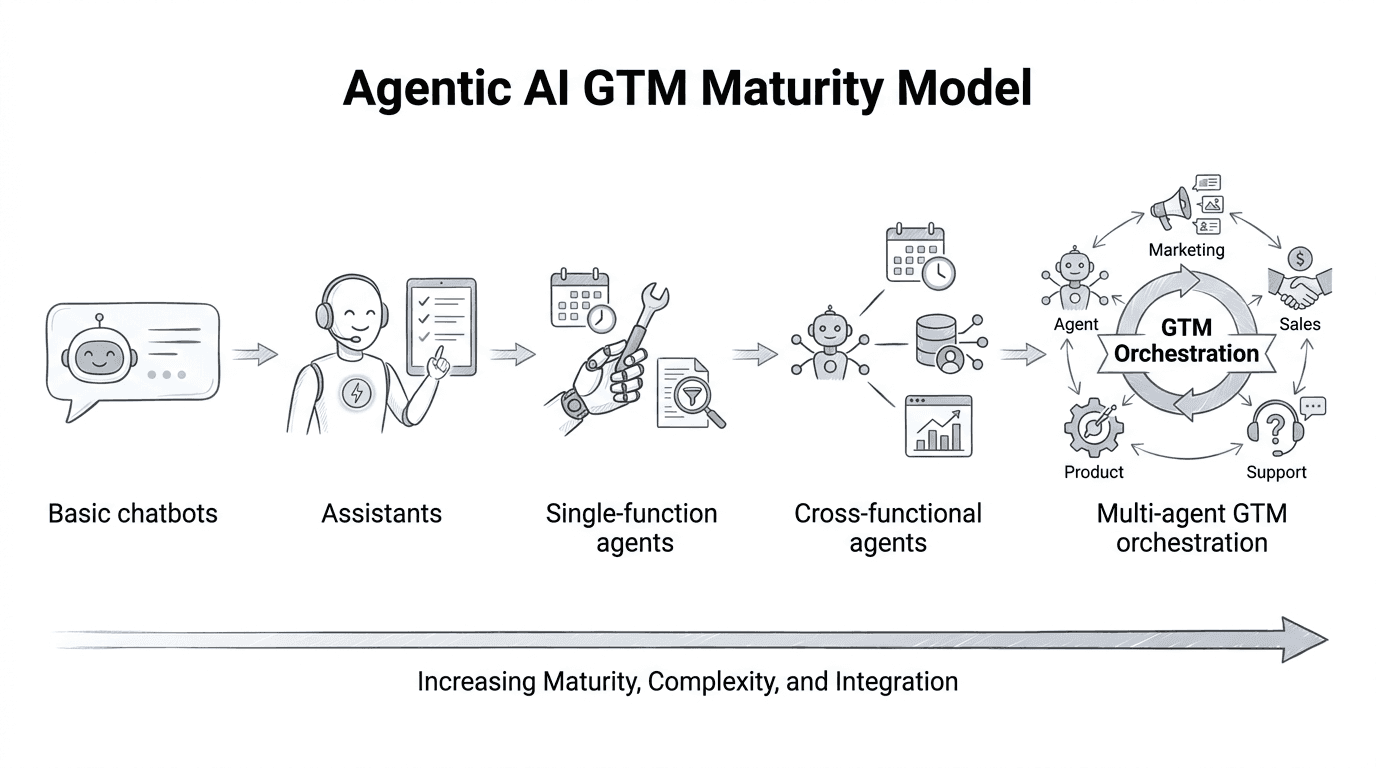
When I think about how companies adopt AI agents, I see it as a maturity curve.
Most teams do not jump straight into fully autonomous GTM. They move through stages.
At the first stage, they use basic chatbots or simple assistants. These tools answer questions, draft text, or help employees move a little faster.
At the second stage, the tools become more context-aware. They can retrieve information, summarize accounts, recommend next steps, or help a rep prepare for a conversation.
At the third stage, agents start doing specific workflows inside one function. A sales agent may qualify leads. A support agent may resolve simple tickets. A marketing agent may generate campaign variations.
At the fourth stage, agents begin coordinating across departments. Marketing signals flow into sales actions. Sales conversations inform customer success. Support issues update product feedback. The agent is no longer just helping one person — it is helping the company operate.
At the fifth stage, multiple agents work together across systems. One agent finds the opportunity, another prepares the outreach, another routes the handoff, another updates the customer record, and another watches for follow-up.
That is the direction things are going.
But each stage requires more discipline.
A simple assistant can be messy and still useful.
A cross-functional agent cannot.
Once an agent touches multiple systems, the company needs stronger data, stronger permissions, stronger review paths, and stronger governance.
I like to think of mature GTM agents as a digital assembly line.
Not in a cold, robotic sense.
More like a connected operating flow where the repetitive parts of GTM stop depending on human memory.
A visitor lands on a page.
An agent reads the intent.
Another agent enriches the account.
Another drafts a follow-up.
Another assigns the lead.
Another prepares the rep.
Another updates the CRM.
Another checks whether the customer needs support after the sale.
That is powerful.
But it only works if the company has prepared the ground.
The systems need to talk to each other.
The data needs to be usable.
The rules need to be clear.
The humans need to know where they fit.
The agents need to be narrow enough to trust.
This is why smaller, focused projects often work better than giant transformation projects.
A founder does not need to automate the entire company on day one.
Start with one painful workflow.
Make it measurable.
Keep the scope tight.
Add oversight.
Watch the output.
Then expand.
That is how maturity compounds.
ROI And Value Creation
Every founder eventually asks the same question:
Does this actually make money?
And that is the right question.
AI agents can sound impressive, but GTM leaders should not care about novelty. They should care about pipeline, conversion, retention, speed, customer experience, margin, and leverage.
The value of agents shows up in a few places.
First, they reduce manual work.
A lot of GTM is not strategic. It is repetitive. Researching accounts. Cleaning CRM data. Writing first drafts. Summarizing calls. Updating records. Sending reminders. Routing leads. Preparing reports.
If agents can handle that, humans get more time for judgment and relationships.
Second, agents speed up response time.
In GTM, timing matters. A lead that gets a fast, relevant response is more valuable than a lead that gets buried for two days. A customer issue handled early is easier than one that becomes a churn risk. A follow-up sent at the right moment can change the outcome of a deal.
Agents are good at watching for moments that humans miss.
Third, agents improve consistency.
Humans forget. Humans get busy. Humans skip steps. Humans take shortcuts. Agents, when designed well, can make sure routine work gets done the same way every time.
Fourth, agents can personalize at scale.
Not fake personalization like inserting a first name. Real personalization based on context, behavior, industry, timing, and intent.
That matters because modern buyers ignore generic outreach.
Fifth, agents can help small teams punch above their weight.
This is especially important for founders. Most early companies do not have enough people. They are trying to run sales, marketing, onboarding, support, customer success, product feedback, and operations with a tiny team.
Agents can create leverage before the company can afford a full department.
But there is an important warning here.
ROI usually comes from focused use cases, not vague ambition.
“Let’s use AI across GTM” is too broad.
A better version is:
Let’s reduce lead response time.
Let’s improve demo show-up rate.
Let’s automate account research.
Let’s speed up support resolution.
Let’s detect churn risk earlier.
Let’s clean CRM data automatically.
Let’s create better follow-up after every sales call.
Specific use cases create measurable value.
Broad AI initiatives often become expensive theater.
The best agent projects are tied to clear business outcomes.
Not “we used AI.”
But “we increased speed.”
“We reduced dropped leads.”
“We improved conversion.”
“We saved manager time.”
“We handled more support volume.”
“We found revenue opportunities earlier.”
That is the kind of ROI founders should care about.
Security Risks And Failure Modes
This is where the excitement needs to slow down.
Agents are powerful because they can act.
But that is also what makes them risky.
A chatbot that gives a bad answer is one problem.
An agent with access to your CRM, email, customer records, billing tools, and internal systems is a different problem.
If the agent has too much access, it can create damage quickly.
It could expose customer data.
It could send the wrong message.
It could update the wrong record.
It could trigger the wrong workflow.
It could make a promise the company cannot keep.
It could hallucinate a fact and send it confidently.
It could be manipulated by a malicious prompt.
It could create a chain reaction across other tools.
This is why I think founders need to treat agents almost like nonhuman employees.
You would not give a new intern access to everything.
You would not let a new sales rep negotiate contracts without training.
You would not let a support rep issue unlimited refunds without policy.
You would not let a marketer send any campaign to any list with no review.
So why would you let an AI agent do those things?
The right design is least privilege.
Give the agent only the access it needs.
Give it a narrow job.
Give it clear boundaries.
Log what it does.
Make sensitive actions reviewable.
Create escalation paths.
Test it before expanding access.
Watch for strange behavior.
Another risk is opacity.
Sometimes the agent does something and the team does not know why. That is dangerous in a business setting. If the agent affects a customer, a deal, a support issue, or a compliance-sensitive process, the company needs a record.
What did the agent see?
What did it decide?
What did it do?
Why did it escalate?
What did the human approve?
What changed afterward?
Without observability, teams cannot trust the system.
There is also the risk of overconfidence.
Agents can sound calm and polished even when they are wrong. That makes them dangerous in customer-facing workflows.
A sloppy human answer often looks sloppy.
A wrong AI answer can look professional.
That is why quality checks matter.
I’ve learned that the safest path is to start agents in low-risk workflows and expand slowly.
Let them assist before they act.
Let them draft before they send.
Let them recommend before they decide.
Let them handle simple cases before complex ones.
Let humans approve until the agent earns trust.
That is not slow thinking. That is how you avoid destroying trust before the system has a chance to prove itself.
Redesigning GTM Processes For Human–AI Teams
The biggest mistake is thinking agents are a drop-in replacement.
They are not.
They change the workflow.
When agents enter a GTM organization, humans should move up the value chain. The goal is not for humans to spend their day fighting the AI or cleaning up after it. The goal is for agents to absorb the repetitive work so humans can spend more time on judgment, strategy, creativity, and relationships.
In sales, the rep should not spend hours preparing basic account notes. The agent should prepare the brief, highlight the opportunity, surface risks, and suggest talking points. The rep should bring judgment and human presence.
In marketing, the human should not manually create ten versions of every message. The agent should generate variations, pull insights, and prepare ideas. The marketer should decide the angle, voice, and strategy.
In customer support, the human should not answer the same basic question fifty times. The agent should handle the routine cases. The human should focus on angry customers, complex issues, and moments where empathy matters.
In customer success, the agent should watch for risk signals and prepare summaries. The CSM should focus on trust, renewal strategy, expansion, and relationship health.
This is the real human–AI team.
Not humans versus agents.
Humans with agents.
Humans above agents.
Humans supervising agents.
Humans using agents to become more effective.
But this requires role redesign.
Someone needs to own agent performance.
Someone needs to maintain the data.
Someone needs to define the rules.
Someone needs to review edge cases.
Someone needs to decide when the agent gets more autonomy.
Someone needs to train the team on how to work with it.
A lot of companies skip that part.
They buy the tool, turn it on, and hope behavior changes.
It usually does not.
People need to know how to use the system. They need to know when to trust it. They need to know when to override it. They need to feel like the AI is making them stronger, not making them irrelevant.
That cultural piece is massive.
If people feel replaced, they resist.
If people feel burdened, they ignore it.
If people feel empowered, they adopt it.
That is why founders should frame agents carefully.
The message should not be, “AI is here to replace the team.”
The message should be, “AI is here to remove the work that slows the team down.”
That distinction matters.
Trust, Transparency, And Governance
Trust is the center of this whole thing.
Without trust, agents do not scale.
Employees will not use them.
Managers will not rely on them.
Customers will not accept them.
Executives will not fund them.
Security teams will not approve them.
Trust is not built through slogans. It is built through design.
The first layer is transparency.
People need to know when they are interacting with an agent. Employees need to know what the agent can access. Managers need to know what the agent is doing. Customers should not feel tricked.
The second layer is explainability.
The agent does not need to write a philosophical essay about every decision, but it should be able to show its reasoning in practical terms.
Why did it qualify this lead?
Why did it escalate this account?
Why did it recommend this message?
Why did it flag this customer?
Why did it choose this next step?
The third layer is human control.
There should be approval points for sensitive actions. There should be override options. There should be clear ownership. There should be a way to pause or roll back agent behavior.
The fourth layer is measurement.
Trust should be tracked.
How often does the agent get overridden?
How often does it escalate correctly?
How often do humans edit its output?
How often does it produce customer complaints?
How often does it save time?
How often does it create new issues?
That is how trust becomes operational.
I also think agents should begin with narrow scopes.
One agent doing one job well is more trustworthy than one general agent pretending to do everything.
A narrow agent can be tested.
A narrow agent can be measured.
A narrow agent can be improved.
A narrow agent can earn more responsibility.
A vague agent becomes hard to govern.
This is one of the biggest lessons for founders: do not sell “AI that does everything.”
Sell a specific agent that solves a painful workflow better than the current process.
That is how trust starts.
Research Methods In Agentic AI Adoption
If I were studying agentic AI adoption properly, I would be careful not to rely only on hype, case studies, or polished success stories.
This space needs better measurement.
There are a few ways to understand what is actually happening.
The first is interviews.
Talk to founders, sales leaders, support leaders, marketers, customer success teams, operators, and employees using these systems every day. Interviews reveal the messy truth that dashboards miss.
Where did the agent help?
Where did it fail?
Where did the team stop trusting it?
Where did it create more work?
Where did it quietly become essential?
The second is surveys.
Surveys help show broad patterns, but they need to be treated carefully. People may say they are “using AI” when they are only experimenting. Others may call a chatbot an agent. Some may exaggerate results because the company wants to look innovative.
The third is ROI analysis.
This is where things get more serious. Look at before-and-after performance. Did response times improve? Did conversion increase? Did support resolution improve? Did churn decrease? Did revenue rise? Did cost-to-serve fall?
But even ROI can be misleading if the company ignores hidden costs like setup, training, review time, cleanup, security, and change management.
The fourth is controlled testing.
Compare teams with and without agents. Compare human-only workflows with human-reviewed agent workflows. Compare high-autonomy agents with supervised agents. Track outcomes over time.
That is where we will learn what really works.
The fifth is product telemetry.
This means studying what actually happens inside the tools: edits, overrides, escalations, approvals, errors, response times, and user behavior.
That kind of data can tell the truth.
But the field still needs better standards.
People need common definitions.
What counts as an agent?
What counts as production?
What counts as ROI?
What counts as a resolved issue?
What counts as a qualified lead?
What counts as a successful autonomous action?
Until those definitions improve, a lot of AI adoption numbers will remain fuzzy.
Implications: Transforming GTM And Beyond
The business implication is simple: GTM is becoming more operationally intelligent.
Sales, marketing, support, and customer success will not remain separate manual functions forever. Agents will connect them.
A marketing signal can become a sales action.
A sales objection can become product feedback.
A support issue can become a success risk.
A renewal signal can become an executive alert.
A customer conversation can update the whole company’s understanding of the account.
That is the real transformation.
Not just faster emails.
A more connected GTM nervous system.
For founders, this changes how companies are built.
A small team can operate with more leverage.
A founder can test more channels.
A sales rep can manage more accounts.
A support team can handle more volume.
A marketer can create more experiments.
A customer success team can catch more risk earlier.
But it also changes the vendor landscape.
CRM tools, marketing platforms, support platforms, and analytics tools will start becoming agent platforms. The question will not just be, “Where do we store data?” It will be, “Which agents can act on this data safely?”
Technology will also change.
Companies will need better agent communication, better observability, better permission systems, better knowledge graphs, better workflow orchestration, and better ways to audit what agents do.
This is a new enterprise architecture.
Instead of humans moving every task manually between systems, agents will increasingly move work across systems.
For society and work, the implications are more complicated.
Some repetitive tasks will disappear. New roles will appear. People who can manage agents, design workflows, understand data, and supervise AI systems will become more valuable.
The danger is that companies use agents only to cut costs.
The better path is to use agents to increase human leverage.
Let people spend less time on administrative drag and more time on work that requires judgment, creativity, empathy, and strategy.
Ethically, companies will need to be clear about how agents interact with customers.
If an agent is negotiating, recommending, pricing, qualifying, or handling sensitive information, there need to be rules. Customers should not be misled. Bias needs to be watched. Privacy needs to be protected. Accountability needs to be clear.
The companies that take this seriously will build more trust.
The companies that do not may create backlash.
Limitations Of Current Knowledge
I want to be honest: we are still early.
A lot of what people say about agents is based on pilots, early deployments, vendor claims, or small samples of success.
That does not mean the opportunity is fake. It means founders should be careful.
The field has a few limitations.
First, definitions are messy.
One company says “agent” and means chatbot. Another says “agent” and means a workflow automation. Another means a real autonomous system with tool access and decision-making ability.
Those are not the same thing.
Second, a lot of performance data is private.
Companies do not always share failures. Vendors usually highlight wins. Teams may not track hidden costs. That makes it hard to know what works across industries.
Third, many examples are still short-term.
A pilot that works for three weeks is not the same as a system that works for three years. Long-term reliability is harder.
Fourth, the technology is changing quickly.
What feels advanced today may become basic soon. What feels risky today may become standard with better controls. The details will change.
But I think the core principle will stay the same:
Agents only create durable value when they are connected to clean workflows, clear ownership, human oversight, and measurable outcomes.
That is the part founders should remember.
Future Research Directions
If I were pushing this field forward, I would want to study a few practical questions.
First, real ROI across industries.
Track sales cycles, conversion rates, support resolution, churn, deal quality, and customer satisfaction before and after agent deployment. Do this across different company sizes and industries.
Second, trust calibration.
Study when humans trust agents too much, when they trust them too little, and how interface design changes that behavior.
Third, security testing.
Build simulations where agents face prompt injection, bad data, permission abuse, and chained workflow failures. See what breaks. Then design better defenses.
Fourth, deep company case studies.
Spend time inside companies adopting agents. Watch the culture change. Watch the workflow change. Watch where employees resist and where they adopt. That would teach us more than polished case studies.
Fifth, benchmark tasks.
Create standard tests for GTM agents: qualify a lead, prepare an account brief, respond to a support issue, draft a campaign, escalate a churn risk, update a CRM record. Then compare agent performance in a more honest way.
Sixth, liability and ethics.
Clarify who is responsible when an agent makes a bad decision. The builder? The buyer? The employee who approved it? The manager who deployed it? The company?
These questions are not theoretical anymore.
As agents touch real customers and real revenue, responsibility matters.
Tying It Together
Agentic AI is going to change how B2B companies run go-to-market.
But not in the lazy way people describe it.
It is not just “AI will replace sales.”
It is not just “AI will write marketing.”
It is not just “AI will handle support.”
The deeper shift is that GTM becomes more connected, more automated, more measurable, and more supervised.
Agents will take on the repetitive motion.
Humans will keep the judgment.
Managers will become supervisors of both people and digital workers.
Founders will build companies with more leverage than before.
But the winners will be the ones who treat this seriously.
They will not chase vague autonomy.
They will not hand agents unlimited access.
They will not confuse demos with deployment.
They will not ignore trust.
They will not pretend governance is optional.
They will start with focused workflows.
They will measure outcomes.
They will keep humans in control where it matters.
They will expand autonomy gradually.
They will build trust through performance.
That is the founder lesson.
AI agents can absolutely change GTM. They can help small teams act bigger, move faster, and serve customers better. But they are not magic. They are a new class of operational teammate.
And like any teammate, they need a role, a manager, a scoreboard, and boundaries.
That is how agents move from pilot to production.
That is how they become useful.
And that is how founders can turn them from an interesting technology into a real advantage.